"Buffalo Tales: Chronicles of Africa's Iconic Grazers"
2024. 6. 9. 01:05ㆍ카테고리 없음
반응형
What is a buffalo?
There is only one species of buffalo in Africa but four distinct subspecies exist: forest buffalo, West African savanna buffalo, Central African buffalo, and southern savanna buffalo (also known as the Cape buffalo).
Savanna buffaloes are large, heavy cow-like animals. They vary greatly not only in size but in the shapes of their horns and their coloring. Adults are usually dark gray or black (or even look red or white if they have been wallowing in mud of that color) and the young are often reddish-brown. The smaller forest buffalo maintains the red color even as an adult, although in western Uganda, many savanna buffaloes are also red or pale orange instead of black. Adults lose hair as they age.
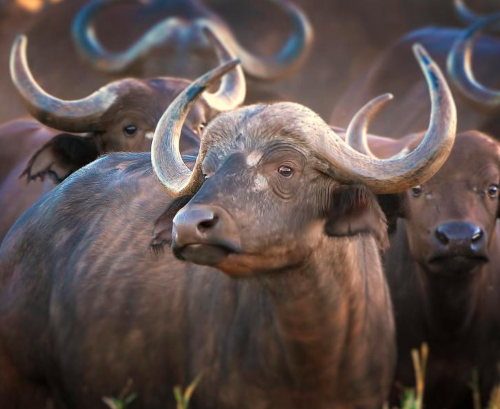
Both males and females have heavy, ridged horns that grow straight out from the head or curve downward and then up. The horns are formidable weapons against predators and are used when jostling for space within the herd; males use the horns in fights for dominance.
SCIENTIFIC NAME
SYNCERUS CAFFER
WEIGHT
ABOUT 300 TO 835 KILOGRAMS (660 TO 1,840 POUNDS)
SIZE
ABOUT 1 TO 2 METERS TALL (4 TO 5 FEET)
LIFE SPAN
11 TO 22 YEARS IN THE WILD
HABITAT
DENSE FOREST TO OPEN PLAINS
DIET
HERBIVOROUS
GESTATION
11 TO 12 MONTHS
PREDATORS
HUMANS, LIONS, LEOPARDS, HYENAS, AFRICAN WILD DOGS
Challenges
African buffaloes frequently come into conflict with humans.
Outside national parks, these giants are considered crop pests and are seen as dangerous animals due to their size, aggressive nature, and formidable horns. In East Africa, they are known to break fences, raid cultivated crops, and they may even spread bovine diseases to livestock. In the past, they suffered their most dramatic population decline during the great rinderpest epidemic of the 1890s. This also coupled with pleuro-pneumonia and caused mortalities as high as 95 percent among livestock and wild buffalo.
Habitat fragmentation threatens the African buffalo.
Their habitat is threatened by fragmentation, which is caused when land is divided by unsustainable development.
Behaviors
Buffalo sometimes congregate by the thousands.
They can live in herds of a few hundred but have been known to congregate in thousands in the Serengeti during the rainy season. Congregating in large herds is one of their many anti-predator adaptations. Large herds decrease the possibility of any individual being singled out by lions. The females and their offspring make up the bulk of the herd. Males may spend much of their time in bachelor groups. These groups are of two types, those that contain males from 4 to 7 years old and those that have males 12 years and older. The older bulls often prefer to be on their own.
Births typically occur during the rainy season.
Females have their first calves at age four or five. They usually calve only every two years, and most births occur at the end of the rainy season when abundant grass improves the nutritional level for females when they are pregnant or nursing. The female and her offspring have an unusually intense and prolonged relationship. Males do not invest in their offspring. Calves are suckled for as long as a year and during this time are completely dependant on their mothers. Female offspring usually stay in the natal herd, but males leave when they are about four years old.
Buffalo senses are quite poor.
Their sight and hearing are both rather poor, but their scent is well developed in African buffaloes. They also seem to have a relatively difficult time regulating body temperature—the reason why they feed mostly at night. Although they are quiet for the most part, the animals do communicate. In mating seasons they grunt and emit hoarse bellows, and a calf in danger will bellow mournfully, bringing herd members running at a gallop to defend it.
Diet
Grass forms the bulk of the buffalo’s diet.
Food sources play more of an important role than predation in regulating population numbers. Without fresh green feed, buffaloes deteriorate rapidly. They devote a large portion of their time to grazing and feeding. After grazing on grass, just like cows, they spend time chewing their cud (or bolus) to extract even more nutrients from their food.
반응형