"The Secret Life of Aardvarks: Earth's Eccentric Excavators Revealed"
2024. 6. 9. 01:06ㆍ카테고리 없음
반응형
What are aardvarks?
They belong to the same group of mammals as the African elephant and have no relation to anteaters despite their similar appearance. They have a short neck connected to a strong, large, almost hairless body with an arched back. Their legs are not proportional to each other; the hind legs are longer than the front ones. They have an elongated head, with a long, protruding, narrow snout and nostrils that can be sealed. Their ears are long and tubular and are normally held upright but can be folded and closed. Their tapered, cone-shaped tail is short and muscular, and they have thick claws on the forefeet that are well adapted for digging.
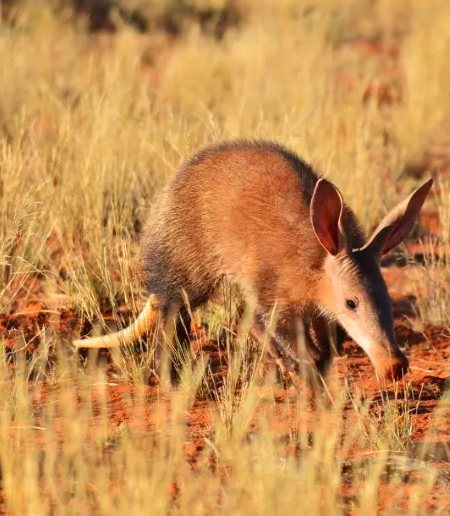
SCIENTIFIC NAME
ORYCTEROPUS AFER
WEIGHT
39 TO 82 KILOGRAMS (88 TO 181 POUNDS)
SIZE
1 TO 1.5 METERS IN LENGTH (3 TO 5 FEET) .6 METERS AT THE SHOULDER (24 INCHES)
LIFE SPAN
18 TO 23 YEARS IN THE WILD
HABITAT
ALL SAVANNA TYPES, RAINFORESTS, WOODLANDS, AND THICKETS
DIET
INSECTIVOROUS, MYRMECOPHAGOUS
GESTATION
AVERAGE 7 MONTHS
PREDATORS
HUMANS, LIONS, LEOPARDS, HYENAS, PYTHONS
Challenges
Aardvarks are hunted by humans.
People hunt this animal for its meat and sometimes use its body parts as charms—the teeth are believed to prevent illnesses. Other animals, like lions, hyenas, and leopards are its natural predators in the wild.
Habitat loss is also a threat to aardvarks.
As human populations grow, logging, agriculture, roads, and settlements destroy their habitats.
Behaviors
Life in an aardvark burrow
Aardvarks love to dig, and their burrows serve as a place to hide from predators. When aardvarks sleep, they block out the entrance to their burrow, leaving only a very small opening at the top, and curl into a tight ball. They frequently dig new burrows, and because other species make use of them, they may be considered a keystone species. Females tend to stay in the same area whereas males wander more.
Aardvarks are a little anti-social—and even inhospitable.
They are mostly solitary mammals and only come together for mating. Even though they are nocturnal, they sometimes come out during the day to sun themselves. Since their eyesight is limited, the aardvark is always cautious when leaving their burrow to forage for termites. When leaving their burrow, they will stand at the entrance, motionless, for several minutes and continue forward with numerous powerful leaps until there are no sounds or threats. They will then move at a slow trot looking for food.
Diet
What do aardvarks eat?
This species is specialized for eating termites. They move from one termite mound to another, dismantling the hills with their powerful claws. Insects are trapped by their long protractile tongue (as long as 30 centimeters), which is covered with thick, sticky saliva. Their impeccable sense of smell allows them to catch termites outside of the mounds. Sometimes they will press their snout against an opening in a mound and suck up the termites.
반응형